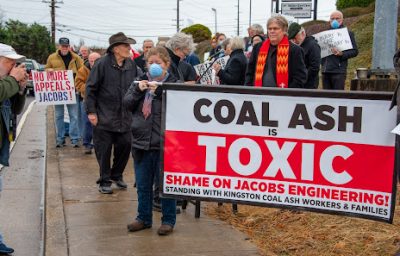
Hundreds of workers who helped clean up after the massive Kingston Fossil Plant coal ash spill have gotten sick and dozens have died. A hearing before the Tennessee Supreme Court was the latest stop in the ongoing battle for justice. [ Read More ]


Friday, June 10th, 2022 | Posted by Brianna Knisley | No Comments
Thursday, January 30th, 2014 | Posted by Amy Adams | No Comments
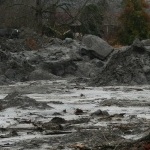 By the end of this year, the EPA will finally publish the first-ever federal rule regulating the disposal of coal ash. The agency’s December 19 deadline is the result of a settlement reached today in a lawsuit brought by Earthjustice, representing Appalachian Voices, Southern Alliance for Clean Energy and other groups. The law, strong science and good public policy all support regulating coal ash as a hazardous waste. Will the EPA stand up for environmental and public health?
[ Read More ]
By the end of this year, the EPA will finally publish the first-ever federal rule regulating the disposal of coal ash. The agency’s December 19 deadline is the result of a settlement reached today in a lawsuit brought by Earthjustice, representing Appalachian Voices, Southern Alliance for Clean Energy and other groups. The law, strong science and good public policy all support regulating coal ash as a hazardous waste. Will the EPA stand up for environmental and public health?
[ Read More ]Thursday, July 25th, 2013 | Posted by Erin Savage | 3 Comments
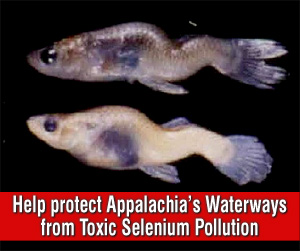
In February, we wrote about the new selenium water quality standards being proposed by the Kentucky Division of Water and urged concerned citizens to express their concern to the state. Now, Kentucky has gone ahead with its proposal, submitting the new standards to the EPA for review. While the EPA may deny Kentucky’s proposed standards, concerns are growing that the EPA, influenced by states beholden to their mining industries, may release its own inadequate standard. That is why we are urging people to tell EPA to stop Kentucky, and to require strong, enforceable standards in every state.
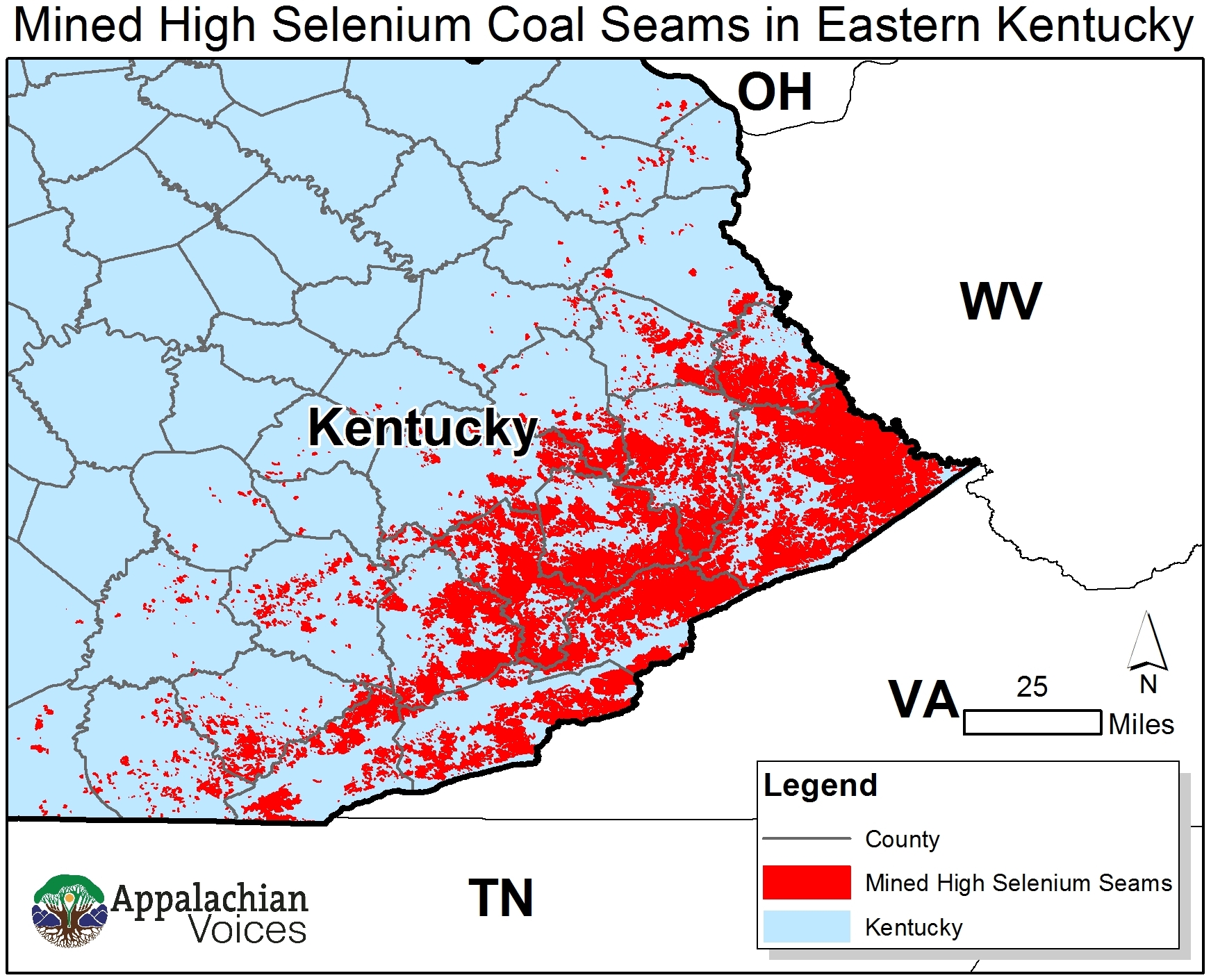
Selenium is of particular concern in Kentucky and other Central Appalachian states because it is often released into streams through mountaintop removal coal mining and is toxic to aquatic life at very low levels. Even though many high-selenium coal seams are mined in Kentucky, companies typically claim there will be no selenium discharge when first applying for a permit, so that the pollutant is not included on the permit. Selenium has rarely been included on mining permits in Central Appalachia, effectively allowing companies to avoid monitoring or treating it, unless citizens force them to with lawsuits. A recent victory in a lawsuits over illegal selenium discharges from a Virginia surface mining operation indicates that selenium pollution is a widespread problem at mountaintop removal mines across Central Appalachia.
Kentucky has faced increased pressure from citizens and the EPA to include selenium standards on pollution discharge permits, so that water quality is adequately protected. Unfortunately for the coal companies, selenium is expensive to treat and difficult to keep out of streams impacted by surface mining in high-selenium coal seams. Adding selenium to permits would mean that many coal companies have to start paying for a much larger portion of the damage they create. It appears that the state is helping coal companies find a way to avoid responsibility for selenium discharges. By increasing the legal limit of selenium allowed in streams and including fish tissue-based standards that are difficult, if not impossible to enforce, the state will allow many companies to continue to skirt their responsibility to the land and the people of Kentucky.
(more…)
Monday, July 1st, 2013 | Posted by | No Comments
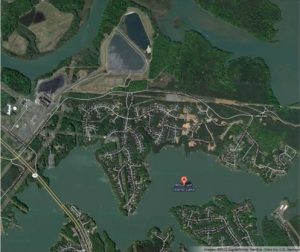
The N.C. Department of Environment and Natural Resources sued Duke Energy to stop coal ash pollution from contaminating Mountain Island Lake, the Charlotte Metro area’s primary drinking water source. Click the photo to watch a short video.
“Passing a bad piece of coal ash legislation prolongs our pollution problem and makes the possibility of an accident much more of a reality.”
These words, from a recent letter to the editor in the Asheville Citizen-Times, reflect the growing discomfort over coal ash storage and how legislators are tackling the problem.
Coal ash is the waste byproduct from burning coal, and is stored in large unlined, earthen ponds, usually near waterways. It contains toxic chemicals such as lead, arsenic and selenium, and can leak from the ponds into groundwater. When improperly constructed and inspected, coal ash ponds can burst — the most horrific example of this occurred in 2008, when a pond at TVA’s Kingston, Tenn., coal plant ruptured and more than 1 billion gallons of the toxic substance surged into local waters and communities. Cleanup efforts are ongoing.
In the wake of the Kingston coal ash disaster many called for federal regulations on coal ash storage. While the U.S. Environmental Protection Agency has repeatedly delayed releasing the rule, which could be released as early as 2014, many at the state and federal level have tried to stop the EPA from doing just that.
(more…)
Friday, December 21st, 2012 | Posted by Sandra Diaz | No Comments
So the world did not end today, as much of the discussion around the end of Mayan calendar seemed to suggest. But it might have seemed like that to the residents of Harriman, Tn. exactly four year ago today, when an earthen dam at a nearby power plant failed, and 1 billion gallons of coal ash waste flooded across fields and farmland and oozed into nearby rivers. The amount spilled is enough to fill 1,500 Olympic-sized swimming pools.
Though no one was directly hurt or killed, the catastrophe at the Tennessee Valley Authority power plant surely devastated lives. People got sick from the fumes coming off the ash and had to boil their water. Property values plunged, compelling people to sell their homes and property to TVA. Dangerous heavy metals were released into the Emory River, a tributary of the Tennessee River.
It was the first time a majority Americans learned what coal ash was and how dangerous it could be. People were shocked to know that a waste product from burning coal was most often dumped into unlined pits behind earthen dams. More shocking is the fact that, in the absence of federal standards coal ash — laced with heavy metals, known carcinogens and other toxins — is less regulated than household waste.
In the Southeast, we know there are 450 of these impoundments holding back 118 billion gallons of coal ash. Not only is there the risk of a dam breaking, there is the more insidious pollution of our waterways. (See if there is one near you).
I will never forget the day Donna Lisenby, Coal Campaign Coordinator for Waterkeeper Alliance, John Wathen, Hurricane Creekkeeper and I traveled to “ground zero” and paddled to where the Emory River ceased being a river and began to look like a sludge pit. It looked like the end of the world.
Little has happened since the TVA spill. Clean-up that was supposed to take a few weeks still isn’t completed. TVA has decided to allow “natural recovery” to take place, which basically means TVA will stop trying to dredge the river and see if Mother Nature might be able to finish the job with the remaining 9% of the ash still left. (more…)
Read More ...Thursday, September 20th, 2012 | Posted by | No Comments
To put it mildly, the supposed coal ash regulation bill S. 3512 falls short of our expectations. The bill — proposed last July by Sens. Hoeven (R-SD), Conrad (D-SD), and Baucus (D-MT) — shields utilities from their obligations to upgrade their unsafe ash dumps in a timely fashion, clean up sites that they have contaminated, or close leaking and unstable ponds and landfills.
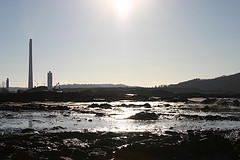
The aftermath of Kingston coal ash spill in 2008
Coal ash ponds are gigantic impoundments that contain the toxic byproducts from burning coal. S. 3512 won’t require deadlines for states to implement a permit program for coal ash ponds. The proposal even prevents the EPA from enforcing any standards contained in this bill, leaving the states free to do whatever they want.
To put it strongly and more correctly, S. 3512 isn’t OK at all. Tell the Senate today that clean water is your right.
(more…)
Thursday, August 23rd, 2012 | Posted by Brian Sewell | 1 Comment
It has been a week of good news in the fight for stronger protections against coal ash pollution. A court settlement in South Carolina and a major decision regarding the 2008 TVA Kingston coal ash spill make for a one-two punch against the poorly regulated toxic waste.

A federal court found that the Tennessee Valley Authority is ultimately liable for the December 2008 coal ash spill. The failed pond at TVA's Kingston Plant released more than one billion gallons of toxic coal ash and covered 300 acres.
This morning, a federal court ruled that the Tennessee Valley Authority is liable for the massive coal ash spill at its Kingston Plant in December 2008. In his written opinion, U.S. District Judge Thomas Varlan ruled that the spill resulted ultimately from TVA’s “negligent nondiscretionary conduct” — far from the unpredictable geologic event that TVA lawyers claimed was the cause during the trial.
In fact, we know more than ever just how preventable the catastrophic spill was. In the months following the event, an engineering firm hired by TVA issued a report that identified the unstable layer of soil beneath the coal ash which had gone undetected for decades as TVA continued to pile on larger amounts of the toxic waste. Subsequent reports revealed internal agency memos that contained warnings that could have prevented the spill. And in his ruling, Varlan was sure to mention that had TVA investigated and addressed the unstable pond, the spill might have been avoided.
Shorty after the coal ash pond failed, it became clear that the Kingston spill would become the worst environmental disaster of its kind in American history. TVA initially estimated that 1.7 million cubic yards burst from the pond and into the Emory and Clinch Rivers. They later had to revise that estimate to more than 5.4 million cubic yards — more than a billion gallons and 100 times larger than the 1989 Exxon Valdez oil spill. (more…)
Read More ...Monday, July 2nd, 2012 | Posted by | No Comments
By Erin Burks
Red, White and Water intern, Summer 2012
 Transportation bill negotiations between the House and Senate came to a close on June 29 and an amendment blocking the U.S. Environmental Protection Agency’s ability to finalize coal ash storage and disposal is out of the picture for now. This amendment, known as Title V was attached as an amendment to the transportation bill by West Virginia representative David McKinley.
Back in June 2010, the EPA proposed two options on how to manage and dispose of coal ash:
The first option would be to classify coal ash as a special waste under the hazardous waste provision (Subtitle C) and allow the EPA continue to regulate it in a fashion similar to hazardous waste when it is stored in landfills and ponds. This option would set forth federally enforceable guidelines, working with states to implement these standards.
The second option would be to manage coal ash under Subtitle D which would to leave it up to the states to determine if coal ash is managed safely, with EPA-recommended guidelines. Common household trash is treated in this manner. This second option does not allow EPA to enforce the standards, instead leaving it up to the states and individual citizens enforce the standards, leaving the EPA with only a finger to shake at states who do not comply with their recommendations.
While the devastating coal ash spill in Kingston, TN, was the impetus for EPA to review coal ash disposal and storage, the EPA has not finalized either of these provisions. Title V would permanently block the EPA from ever doing so.
Read More ...Tuesday, January 10th, 2012 | Posted by Molly Moore | No Comments
December 22 marked the three-year anniversary of the disastrous coal ash spill at Tennessee Valley Authority’s Kingston Fossil Plant. Residents of the damaged Swan Pond community are still struggling with the impacts of relocation and pollution. But the toxic effects of the more than 1 billion gallons of coal ash that flooded the Clinch and Emory Rivers are now affecting new neighbors.
In Alabama, residents of the state’s poorest county have issued a civil rights complaint against the Alabama Department of Environmental Management, alleging that the agency is discriminating against the largely African-American community by allowing a nearby landfill to accept over half of the coal ash from the TVA disaster.
As The Institute for Southern Studies reported,
The operation of the Arrowhead Landfill in rural Perry County, Ala. “has the effect of adversely and disparately impacting African-American residents in the community,” states the complaint, filed this week with the U.S. Environmental Protection Agency’s Office of Civil Rights by Florida attorney David A. Ludder on behalf of 48 complainants, almost all of them living near the landfill.
The complaint charges ADEM with violating Title VI of the Civil Rights Act of 1964, which prevents discrimination by government agencies that receive federal funds. ADEM receives millions of dollars in financial assistance from the EPA each year.
Moving TVA coal ash to the Arrowhead Landfill in Alabama has been controversial since the deal’s approval in 2009. According to a blog about state corruption, investors and the Alabama Department of Environmental Management said the cash-strapped county would gain $3 million by storing the coal ash, and ADEM stands to make just as much. A citizens’ group called Impact Perry County filed a complaint alleging that the Perry County Commission violated the state’s open meetings and open records laws. Further, the company behind the landfill, Perry Uniontown Ventures, was accused of a “take the money and run” scheme after it filed bankruptcy in Jan. 2010 to avoid environmental lawsuits, the Perry County Herald reported.
In a blog post, the Perry County Herald wrote:
The investors who are taking the bulk of the $95 million generated by the coal ash contract will never have to set foot in our county again once the landfill outlives its usefulness. They’ll never drink our water, or breathe our air, or eat bream from our creeks. They can call the shots from offices with glitzy addresses, never get a speck of ash on their hands, and endorse fat checks until those pristine fingers need a latte break. Can you?
In Perry County, over 68% of the population is African-American and over 35% live below the poverty line. The population in the census blocks surrounding the landfill ranges from 87 to 100 percent African-American. As The Institute for Southern Studies reported,
The landfill sits only 100 feet from the front porches of some residents, who say they have experienced frequent foul odors, upset appetite, respiratory problems, headaches, dizziness, nausea and vomiting. They also complain that fugitive dust from the facility has contaminated their homes, porches, vehicles, laundry and plantings.
Coal ash is a dangerous by-product of burning coal for electricity that contains heavy metals such as arsenic, lead, mercury, manganese, and selenium that are known toxins. People living near an unlined coal ash pond are at a 1-in-50 risk of cancer from arsenic, a rate that is 2,000 times greater than the acceptable level of risk.
Currently, the federal government has no authority to regulate coal ash, which is the nation’s second-largest waste stream after municipal garbage. Read more about proposed protections from coal ash here.
While the EPA and federal government continue political wrangling and delays over regulation of coal ash disposal, the citizens of Perry County are calling out their state’s environmental agency, arguing that, by using Arrowhead Landfill as a dumping ground for toxic waste, the state is engaging in discrimination against the landfill’s neighbors.
Wednesday, November 2nd, 2011 | Posted by Sandra Diaz | 1 Comment
Yesterday, we wrote about a bluff containing coal ash pond breaking, allowing a football field chunk of debris into Lake Michigan. According to a We Energies spokesman “it is probable that some of the material that washed into the lake is coal ash”.
The dangers of coal ash have been made apparent through the coal ash disaster which spilled over a billion tons of coal ash into the Emory River in December 2008. This disaster prompted the EPA to study the issue. They found that there were several dozen high-hazard structurally-insufficient coal ash dam across the country, and initiated a rule-making on how to handle coal ash.
Coal ash is the toxic by-product of coal-burning, and there are hundreds of coal ash ponds littering the country. North Carolina tops the list of high-hazard dams, with 12 coal ash dams from the French Broad River in Western North Carolina to Cape Fear River in eastern North Carolina.
Rachel Maddow covers the coal ash pond wall break, as well as the U.S. House of Representatives’ vote on H.R. 2273, which would block the EPA’s efforts to protect communities from this danger.
Unfortunately what she failed to do is to mention that a virtually identical bill has been introduced in the Senate. After watching this video, please email your Senator and ask them to oppose S.1751 and stand up for our waterways and safety.
Visit msnbc.com for breaking news, world news, and news about the economy
Tuesday, November 1st, 2011 | Posted by Thom Kay | No Comments
There should be zero “significant” hazard coal ash ponds in the United States. The catastrophic collapse of TVA’s Kingston coal ash pond should be a one-time event. Congress should be fighting to protect citizens from another spill.

Unfortunately, there are 181 “significant” hazard coal ash ponds, according to EPA’s latest assessment of coal combustion waste impoundments across the country. A “significant” hazard coal ash pond, based on criteria from the National Inventory of Dams (NID), “can cause economic loss, environmental damage, disruption of lifeline facilities, or impact other concerns.” In 2009, the EPA reported only 60 such ash ponds. What’s worse is that there are 47 “high” hazard coal ash ponds, and the failure of any one of them would likely lead to loss of human life.
In other words, there is no reason to believe that the spill in Kingston, Tennessee in 2008, which released a billion gallons of toxic coal sludge over 300 acres of land, was a one-time event. There are no federal regulations for coal ash ponds, just a patchwork of weak and often unenforced state regulations.
The EPA is trying to do something about this, but people like Rep. David McKinley (R-WV) have fought to stop them. He sponsored a bill that would prohibit EPA from creating federally enforceable guidelines for safer coal ash storage. The bill passed the House and is on the way to the Senate, where Appalachian Voices is working with allies to defeat it.
The pro-coal bill is being pushed by big utilities and coal companies, touting a false jobs argument while protecting their profits at the expense of the public. In truth, they like coal ash ponds because they are cheap ways to dispose of ash and do not create jobs they have to pay for.
Though I suppose that’s not always the case: the Kingston spill has cost $1 Billion, and, over two years later, still employs 450 people six days a week to clean it up. So for those of you at home keeping count, that’s 550 workers in Tennessee shoveling coal out of the ground, and 450 workers scooping toxic coal sludge off the ground.
Friday, October 14th, 2011 | Posted by Sandra Diaz | 1 Comment

Congressman Heath Shuler Stood Up for Communities Today
Today, Congressmen Heath Shuler (NC), David Price (NC), Mel Watt (NC), Brad Miller (NC), John Yarmuth (KY), Gerry Connolly (VA) and Frank Wolf (VA) voted against H.R. 2273 , the Coal Residuals Reuse and Management Act, a bill that does nothing to protect our communities from the dangers of toxic coal ash.
Though we are disappointed that H.R. 2273 did achieve passage on the floor of the House today by a 267 to 144 vote, we are pleased that these members of Congress had the strength and courage to stand for communities who live near high-hazard coal ash dams, across Appalachia, the Southeast and the country.
H.R. 2273 does not provide any true safeguards against the danger of coal ash and subverts the U.S. Environmental Protection Agency’s public rule-making process already in progress. More than 450,000 Americans have commented on EPA proposals to address coal ash pollution and dam safety — H.R. 2273 essentially drowns out their voices. You can read more about this dangerous bill in our blog post from yesterday. (more…)
Read More ...